

Kansas business name search starts with the Secretary of State’s entity database, because that register decides whether a proposed name is available for an LLC, a corporation, or a partnership. A name is available when it is distinguishable from every name already on file, and Kansas applies a comparison rule that ignores punctuation and entity designations before it matches the remaining words. The same search shows which names are in use and whether the entity that holds a name is still active.
This page covers the naming rules, the reservation process, the difference between a legal name and an assumed name, and the offices that hold each record. It is written for founders choosing a name, owners changing one, and buyers checking whether a business legally holds the name it uses. Charges appear only in the table below.
How to Search Kansas Business Names
The entity search is the first stop for a legal name, but it is not the only register that matters. This Kansas Business Name Search guide starts there because assumed names sit in a separate state filing, trademarks sit with the state and the federal government, and a national brand can block a name that Kansas would accept. A complete check touches more than one place.
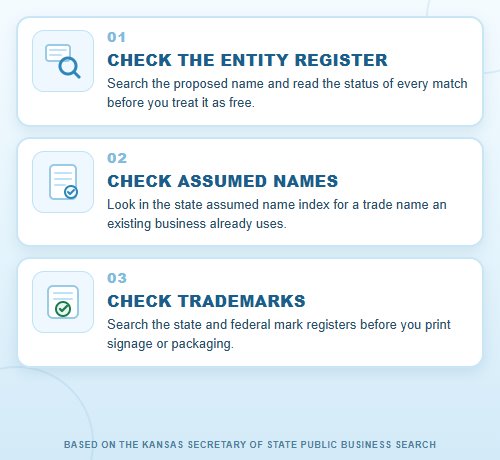
Search the Entity Register
Enter the distinctive word from the proposed name and review every result. Kansas matches on words, so a query for “Prairie” returns every entity with that word in its name, including active, delinquent, and forfeited ones. Read the status before you treat a name as taken, because a forfeited entity may still block a filing until it is reinstated or released.
Compare the normalized forms rather than the display forms. That comparison is the same one the office runs before it accepts a filing, so a name that fails here will fail at the counter. “Prairie State Logistics LLC”, “Prairie State Logistics L.L.C.”, and “Prairie State Logistics Limited Liability Company” are treated as the same name for availability purposes even though they look different on the page.
Search Assumed Names
A second name used by an existing business sits in a state filing rather than in a county office, so one lookup covers the whole state. A search on the assumed name can find the filing, and the filing names the entity behind it. A name search that ignores this register can miss an existing user.
Search Trademarks
Kansas registers trademarks and service marks with the Secretary of State, and the federal register sits with the United States Patent and Trademark Office. The state search covers marks used in Kansas, while the federal search covers marks used in interstate commerce. Check both before printing signage or packaging.
Check the Web and the Domain
The state register does not know about a business that operates online without a Kansas filing. Search the name in a major search engine, check the matching domain, and look at the social handles before you commit. A name that is free at the state level can still be unusable because a national brand already holds it.
A search that fails on the first spelling is not a dead end. Kansas holds a name exactly as it was filed, so a business that trades as “Cafe” may sit under a plural, an extra word, or a different word order. Try the initials, a shortened form, and the surname before you decide the name is free. The same habit helps in the assumed name index, where a trade name often uses the spelling the owner prefers rather than the legal form. Write each variant down as you try it, so a later partner does not repeat the list.
Business name search and reservation:
https://www.sos.ks.gov/eforms/BusinessEntity/Search.aspx
Rules for a Distinguishable Kansas Name
Kansas does not ask whether two names sound alike in conversation. It applies a written test that strips punctuation, case, and entity designations, then compares the remaining words. That test accounts for most rejections and most surprises.
Required Words by Entity Type
An LLC name must contain “Limited Liability Company”, “L.L.C.”, or “LLC”. A corporation name must contain “Corporation”, “Incorporated”, “Corp.”, or “Inc.”. A limited partnership must carry “Limited Partnership” or “L.P.”, and a limited liability partnership must carry “Limited Liability Partnership” or “LLP”. The designation is part of the legal name and appears on every filing.
Suffixes and Punctuation
The state ignores periods, commas, ampersands, hyphens, and capitalization when it compares names. It also ignores the designation, so “Bluebird LLC” and “Bluebird Inc.” collide for availability even though they are different entity types. Add a distinguishing word rather than changing punctuation when a name is already in use.
Names That Are Too Similar
Kansas treats names as the same when they differ only by a designation, an article, a conjunction, a plural, or a small spelling variation. “The Prairie Bakery LLC” and “Prairie Bakery LLC” collide. “Prairie Bakery’s LLC” also collides. A genuinely new word, a distinct location, or a different order of words usually clears the test.
Restricted and Prohibited Words
Some words need approval or are barred outright. Bank, trust, insurance, and credit union suggest regulated activity and usually require a consent from the regulating agency. Words that imply a government connection are restricted. A name that suggests a professional license may need the license before the state accepts the filing.
Reserving a Kansas Business Name
A reservation holds a name while the owner prepares the formation filing. Kansas charges a modest fee for the reservation, and the application can be renewed by repeating the filing. A reservation is optional, and many founders simply file the formation document with the name they want.
When a Reservation Makes Sense
A reservation helps when a lease, a loan, or a franchise agreement depends on the name, or when the owner needs time to raise capital before filing. It also helps when several people are negotiating over a name and one of them needs to lock it. For a single founder filing within a week, the reservation adds a fee without adding much protection.
Reservation Does Not Create a Business
A reservation does not form an entity, does not create liability protection, and does not give the owner a trademark. It only stops the state from accepting the same name from someone else during the reservation period. The business still needs a formation filing, a resident agent, and its tax registrations.
Assumed Names in Kansas
An assumed name, also called a DBA, is the name a business uses in public when it differs from its legal name. Kansas files assumed names at the state level, which means one filing covers the whole state rather than a county-by-county patchwork.
Who Files
An individual, a partnership, an LLC, and a corporation can all file an assumed name with the Secretary of State. The filing names the owner and the assumed name, and it becomes a public record. A business with several trade names files one for each.
Renewal
A Kansas assumed name does not last forever. It has its own renewal cycle, and a lapsed filing weakens a claim that the business holds the name. Put the renewal date in the same calendar as the information report, because both follow the state schedule.
Assumed Name and Trademark Are Different
An assumed name identifies the business, while a trademark identifies a product or service and its source. An assumed name filing is a disclosure, not a grant of exclusive rights. A trademark registration is a state or federal right that can be enforced against later users, and the two processes run in different offices.
Changing a Kansas Business Name
An existing entity changes its legal name by filing an amendment with the Secretary of State. The amendment is a state filing with a fee that depends on the entity type, and it takes effect when accepted. The entity ID stays the same, which keeps the entity history and its contracts intact.
What the Change Touches
A name change usually requires a new bank signature card, an update to the tax accounts, a new assumed name filing if the old one no longer matches, and a notice to customers and vendors. The state filing is the easy part. The follow-up work is what keeps a contract enforceable when the counterparty still has the old name on file.
Name Change and the Record
The filing history keeps both names, and the current record shows the new one. A buyer who searches the old name may find nothing, so a seller should disclose the former name in a contract or a due diligence package. The Kansas business registration page covers the filing that follows a name decision.
Checking a Name Before You File
A practical check takes a few minutes and prevents a rejected filing and a lost fee. Work through the list in this order so that a clear result at the state level is not wasted by a conflict later.
- Entity register. Search the distinctive word and read the status of every match.
- Assumed names. Check the state assumed name index for an existing user.
- Trademark search. Check the Kansas register and the federal register.
- Domain and web. Check the matching domain, the search results, and the social handles. Search the exact spelling the business will print on signage, because a shortened form can clear while the full form is taken.
- Restricted words. Confirm whether the name needs a consent or a license.
Kansas Name and Filing Fees
The list below covers name filings and the formation documents that follow them. A portal submission costs less than a mailed one. The current schedule replaced earlier rates, so verify the figure on the current form.
| Name filing | Fee | Notes |
|---|---|---|
| Reservation of name | $30.00 | Portal $30; mail $35 |
| LLC articles of organization | $85.00 | Online $85; paper $90 |
| Corporation articles | $85.00 | Online $85; paper $90 |
Name Conflicts and How They Resolve
The state decides availability, but it does not decide who owns a name in the marketplace. A conflict between two businesses is a private dispute unless one of them holds a trademark registration. A trademark owner can send a demand letter, oppose a registration, or sue, and the state filing does not settle the question.
A business that adopts a name already used by a national brand can face a demand even when the state accepted its filing. The cost of a rebrand usually exceeds the cost of a search, which is why a trademark check belongs in the naming process rather than after the signage is printed.
When Kansas Rejects a Name
A rejection is not final. The usual reason is that the proposed name is not distinguishable from one already on file, and the fix is a new word rather than a new form. Read the rejection notice before filing again, because the notice names the conflicting entity and the filing that created it.
Some rejections come from a restricted word that needs a consent from another agency. A bank or trust name needs a letter from the state regulator, and an insurance name needs a letter from the insurance division. The consent is obtained first and attached to the filing, which means the delay sits with the other agency.
Names and the Formation Filing
The name becomes final when the office accepts the formation document. The paper must repeat the approved wording exactly, including the designation, because the office compares what it receives with what it reserved.
Copy the name from the approved reservation rather than retyping it. A stray space, a different ampersand, or a switched word is enough to create a second name that the state treats as new. The Kansas LLC records page shows how the name appears on the record after acceptance, while a corporation record shows the corporate version.
A name that clears the register can still fail at the bank. The account title must match the legal name, and a trade name needs its own filing. Decide both before the first deposit.
Names and Multi-State Expansion
A business that plans to operate in several states should check each register before committing to a name. Kansas may accept a name that another state has already taken, and the company then faces a choice between a different name there and a legal fight. A national brand check is cheaper than a state-by-state confrontation later.
A foreign entity that registers in Kansas keeps its home name unless that name is unavailable here. When the name is taken, the entity registers under an assumed name for use in Kansas and discloses the home name on the application. That detail appears in the Kansas record and accounts for a name that does not match the home certificate.
Names for Nonprofit and Membership Groups
A nonprofit corporation follows the corporate naming rules, and it may not use a name that implies an official connection with a government agency. A membership organization may add “Association” or “Society” when the word is not restricted for the activity. Federal exemption has its own expectations, and a name that misleads donors can complicate the exemption application.
A charity that intends to raise funds nationally should check the federal trademark register and the charity registration rules in the states where it solicits. A Kansas filing is one layer, and a name that is clear here can still conflict elsewhere.
The Name and the Bank Account
A bank compares the name on the account with the name on the state record. If the account uses the legal name, the articles or the certificate are enough. If the account uses an assumed name, the bank will also ask for the assumed name filing, because that document is what connects the trade name to the entity.
A mismatch between the state name and the account name is easy to describe and hard to fix after the fact. A business that signs a lease under one name and opens an account under another can end up with a payment that the bank cannot match to the contract. Fix the name before the money moves.
After an amendment posts, ask the bank for a new signature card and a new account title, and send the acknowledgment with the request. A bank that sees the amendment date can update the file in one visit rather than three.
When a Reservation Expires
A reservation that lapses frees the name for anyone else to file. A founder who reserved early and then delayed the formation can lose the name to a competitor who files during the gap. The renewal is the same filing as the original, so the fix is straightforward if the owner notices before the date.
Track the expiration date with the formation checklist rather than in memory, and write it beside the planned filing date so the two cannot drift apart. A lapsed reservation frees the exact wording for a competitor, not merely a similar one. A name that was available in January can be gone by April, and the state has no obligation to warn the holder. The reservation is a placeholder, not a promise.
A short list of candidate names can be checked in one sitting, and the cost of the check is small against the cost of a later change. Rank three names before you file, so a rejection does not stop the whole plan.
What the Name Search Cannot Tell You
The register confirms whether the state will accept a name. It does not confirm that the name is free of trademark rights, that the domain is available, or that another business in another state is not using it. It also does not protect the name: a Kansas filing creates no exclusive right beyond the register.
The search also does not show unregistered rights. A business that has used a name for years without a trademark registration may still have rights under state law, and a new registrant can be forced to stop using the name. A search is a screening tool, not a clearance opinion.
Frequently Asked Questions
The questions below come from founders choosing a name and from owners changing one. Every reply names the rule or the office that decides it.
How do I check if a business name is available in Kansas?
Search the entity database for the distinctive word, then check assumed names and the trademark registers. A name is available when no existing record is distinguishable and no restricted word requires a consent.
How long does a Kansas name reservation last?
The reservation holds a name for a limited period and can be renewed by filing again. It does not create an entity or a trademark, and it does not stop another business from using the name in commerce.
Can two Kansas businesses have the same name?
Not on the entity register. The state rejects a name that differs only by punctuation, a designation, or a small variation. Two businesses can use the same assumed name in different markets, and an assumed name creates no statewide exclusivity.
Where do I file a DBA in Kansas?
With the Secretary of State, not with a county clerk. The state assumed name filing covers the whole state, and it is filed through the same portal that handles entity formation.
Does a Kansas assumed name protect my brand?
No. An assumed name filing is a disclosure, not an exclusive right. Protection comes from a trademark registration and from actual use in commerce, and those are separate from the state filing.