

Kansas corporation search returns the state record for a for-profit or nonprofit corporation registered with the Secretary of State. The record returns the corporate name and number, the type, the status, the incorporation date, the office and agent, the officers and directors, and the papers filed. Because Kansas keeps corporations, LLCs, and partnerships in one index, the type field is what separates a corporation from everything else.
This page is about the corporate side of that index. It covers how to query a corporation, what each corporate field proves, how shares and officers appear, how the biennial information report fits together, and how a corporation from another state appears alongside domestic filings. It is written for directors checking their own filings and for buyers checking a corporate vendor. Only the table carries amounts.
How to Search Kansas Corporation Records
The portal accepts a corporate name, a number, or a person, and the result list mixes entity types. This Kansas Corporation Search starts with the type field, since an LLC in the next town can carry almost the same name. A forfeited corporation is easy to skip once you read the status column.
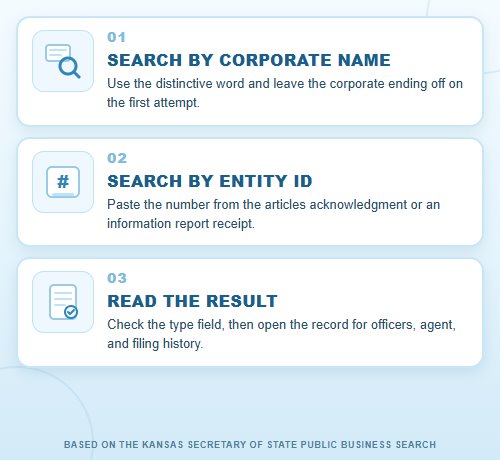
Search by Corporate Name
Start with the word that carries the identity and leave the designation for later. Kansas stores Inc., Incorporated, Corp., and Corporation inconsistently, so the suffix can hide a record. Strip punctuation and any leading The, then match the entity ID rather than the wording.
Search by Entity ID
A number lookup returns a single record when every character is right. The number is printed on the incorporation acknowledgment, on each report receipt, and on a standing certificate. Paste it rather than typing it, and leave out spaces and dashes.
Reading the Corporate Result
A corporate result shows the name, the entity ID, the type, the status, and usually the formation date and registered office. Open the detail record to see the agent, the officers and directors, and the filing history. That record is the document a bank or a buyer will ask you to keep.
Corporate filings and information reports:
https://www.sos.ks.gov/eforms/BusinessEntity/Search.aspx
Reading a Kansas Corporation Record
The corporate page is terse, and each line settles a separate question. Read the fields in sequence, because a name match is not an ownership match. Kansas does not publish a shareholder schedule, so the officers and directors on file are not the owners, and the record cannot tell you who holds the shares.
Corporate Name and Type
The charter name is the one on the articles, and it carries a required ending. The type field keeps a for-profit apart from a nonprofit and from an LLC with a similar name. The distinction matters because the report cycle, the governance rules, and the fee all follow the type.
Entity ID and Incorporation Date
The entity ID follows the corporation for life; it does not change when the name changes, the office moves, or the agent is replaced. The incorporation date is the day the articles were accepted, which is rarely the day trading began. Between them, those two fields settle contract authority, tax years, and claims about how long the business has existed.
Corporate Status
The status line reads in four values. Registered and up to date is active. A report past its due date produces delinquent, though the charter survives. State action after repeated noncompliance forfeits the charter, and a vote by the board and the shareholders produces a dissolution. Only the last of those is voluntary.
Registered Office and Resident Agent
Service of process and official correspondence arrive at the registered office, which must be a physical Kansas address. The agent can be an individual resident or a business entity authorized to transact business in the state. The principal office listed is the operating address the company reported, and it may lag a move by several months.
Officers and Directors
Kansas corporations report officers and directors, including a president and a secretary in most filings. The record does not show how many shares each person holds, and it does not show every officer of a large company. A signer whose name is absent from the record may still have authority under the bylaws, but a buyer should ask for the resolution that proves it.
Filing History
The history collects the articles, every information report, amendments, agent changes, mergers, and the dissolution. A hole in that sequence usually means a forfeiture followed by a reinstatement. Where a long-lived corporation shows only a few entries, ask whether documents were filed under an earlier name.
Shares and Corporate Records
The articles state the number of authorized shares, and that number shapes how the corporation can raise money and how it records ownership. The public record shows the authorization, not the issuance. A corporation authorized for a million shares may have issued ten, which is why the stock ledger matters more than the record when ownership is disputed.
Par value is a separate field from the share count. A corporation can set a par value of one cent or none at all, and the figure affects how the shares are recorded on the balance sheet rather than what they cost. A buyer who reads only the authorized count can miss a class of preferred shares that carries different voting rights or a liquidation preference.
Classes of stock matter for control. Ordinary shares usually vote in practice, while preferred shares often carry a preference on dividends or a return of capital, and the articles state which classes exist and what each may do. That detail changes how a control block is valued. Read the articles for the class structure before assuming one share equals one vote.
Kansas does not impose a franchise tax on the authorized share count, so the corporate filing cost stays flat regardless of the number in the articles. An amendment to change the count is a separate filing, and it carries its own fee.
The Report Cycle for Corporations
A for-profit corporation reports every second year. The deadline lands on April 15 of the filing year, and the form asks for the resident agent, the registered office, and the officers and directors, which is the part that changes most often. Skip it and the charter can be forfeited.
A nonprofit corporation follows the same form but a different fee, and its federal obligations run separately. Mixing the two calendars is a frequent source of confusion when one person serves on the board of a company and a charity.
How a Kansas Corporation Is Formed
Forming a corporation takes one filing with the state plus a set of papers the office never sees. The articles create the corporation. The bylaws, the organizational meeting, and the share issuance happen after the filing and stay with the company.
Articles of Incorporation
Submission runs through the state portal, and the document carries the corporate name, the agent, both offices, and the authorized shares. The charge appears in the table below. The charter takes effect on acceptance, and the acknowledgment holds the entity ID.
Bylaws and the Organizational Meeting
The bylaws set the board size, the officer roles, the meeting rules, and the voting thresholds. The organizational meeting appoints the first directors and officers and adopts the bylaws. Neither document is filed with the state, but a bank and a court will ask for them when authority is disputed.
Not every decision needs a meeting. A written consent signed by all directors can authorize a loan, a lease, or a share issuance, and it takes effect without a call. The consent should state the action, the date, and the signers, and it should be signed before the transaction rather than after it. An officer who acts without one can still bind the company, but the board may later dispute the act. A consent that names a dollar limit and a specific transaction is stronger than a general authorization to act, and a reviewer will compare it with the contract date. Keep the signed original, not only a scan, because a buyer may ask to see the ink signature.
Share Issuance
Shares are issued by board resolution and recorded in a stock ledger. Kansas does not require the ledger to be filed, but it is the document that proves ownership. Update it whenever shares transfer, because a stale ledger is worse than no ledger in a dispute.
Nonprofit Corporations
The nonprofit route uses articles that describe a charitable or mutual purpose, and no shares are issued. It reports on the state schedule with a lower fee than the for-profit rate. State nonprofit status does not create federal tax exemption; the exemption is granted by the Internal Revenue Service on its own form.
The record looks similar to a for-profit record at the top and differs in the middle. Directors replace shareholders, and the purpose clause carries more weight. A buyer checking a nonprofit vendor should confirm both the state registration and the federal exemption, because one does not prove the other.
Foreign Corporations in Kansas
An out-of-state corporation entering Kansas applies for authority and appoints an in-state agent. The jurisdiction field records its home state and the date that authority began. From then on it files the Kansas information report and keeps a Kansas registered office.
A missing record does not prove the company is unregistered elsewhere, nor that it is small. The home-state record and the Kansas record are separate, and a buyer checking a foreign vendor should read both.
Kansas Corporation Fees
Corporate charges appear below, including the nonprofit rate, which is far lower than the for-profit figure. The portal price undercuts the mail price on the for-profit and report lines. Check the schedule at the counter, because the amounts shown here follow the latest reset.
| Corporate filing | Fee | Notes |
|---|---|---|
| Articles of incorporation | $85.00 | For-profit; online $85, mail $90 |
| Articles of incorporation | $20.00 | Nonprofit; same online or mail |
| Biennial information report | $90.00 | Online $90; paper $110 |
Mergers, Conversions, and Dissolution
A merger combines two or more corporations into one, and the survivor keeps its own entity ID. A conversion changes the entity type without creating a new company, and the entity ID continues under the new type. Each transaction has its own filing and fee, and each one appears in the filing history.
Closing a corporation takes a board vote, a shareholder vote, and articles of dissolution. Kansas asks for no separate tax clearance, yet the Department of Revenue account still has to be wound down and one last report filed. Any trading after acceptance is done without the protection the charter provided.
A voluntary close and a state closure read differently to anyone who checks. The first follows a vote and leaves an orderly sequence; the second interrupts the record and needs a reinstatement to fix. A reviewer reading the history will ask about the second and rarely about the first.
Officer Changes Between Reports
Officers change more often than owners, and Kansas does not require a filing for every change. A corporation can replace its president or secretary and report the new slate at the next information report. The public record may lag the meeting by months, which is why a signature that depends on a title needs a resolution rather than the listed name.
An interim notice exists for the cases where the change cannot wait, but most small corporations simply report at the next cycle. Keep the minutes that show the appointment, and produce them when a reviewer asks why the record differs from the signature block.
Board Resolutions and Signing Authority
A corporation acts through people, and the resolution is what connects a person to the company. The bylaws name the officer roles, and a board resolution grants specific authority for a loan, a lease, or a large contract. A bank will ask for both before it opens an account or funds a line of credit.
The resolution should name the signer, the transaction, and the limit. A general resolution that says any officer may sign anything is easy to draft and hard to defend when a dispute turns on authority. A specific resolution is shorter and stronger, and it takes minutes to adopt.
Keep the resolutions in the same file as the bylaws and the stock ledger. A buyer who reviews the corporate record will ask for all three, and a file that holds one without the others leaves the authority question open.
What a Lender Reads
A lender reads the corporate record for three things: continuity, authority, and disclosure. Continuity asks whether the corporation filed every report and stayed active. Authority asks whether the signer could bind the company. Disclosure asks whether a merger, a name change, or a dissolution was left out of the application.
The certificate of good standing answers the continuity question on a specific date, and the record supplies the history behind it. A gap in the filing history invites a question, even when the current status is active. The lender may ask for the reinstatement date and the reason for the gap.
A corporation that changed its name should disclose the former name in the loan file. A search on the old name returns nothing, and a lender that finds the mismatch late may delay funding while it asks for the amendment. The Kansas LLC records page covers the parallel questions for a borrower organized as an LLC.
Records for a Public Bid
A public bid package usually requires a certificate of good standing, a copy of the articles, and proof of tax registration. The buyer is confirming that the bidder exists, that it is current, and that it can invoice the state. A package missing one of the three is set aside before the technical review.
The certificate must be recent, and the name on it must match the name on the bid. A bid submitted under an assumed name without the legal entity behind it is a frequent reason for disqualification. Attach the assumed name filing when the bid uses a trade name.
Before a bid, check that the corporate name still matches the name the business uses in public. A name change that was filed but not reflected in the bid documents is easy to fix early and expensive to fix after submission.
The Stock Ledger and Ownership
The state record identifies the corporation; the stock ledger identifies the owners. The ledger lists each shareholder, the number of shares, the certificate number, and the date of issue, and it is updated whenever shares transfer. Kansas does not require the ledger to be filed, which is why a buyer has to ask for it.
A corporation without a current ledger is hard to buy and hard to finance. A lender wants to see who controls the shares, and a buyer wants to know that the seller owns what is being sold. If the ledger is absent, prior tax returns and bank statements can reconstruct the position, though the rebuild should be labeled as a reconstruction rather than the original.
What the Corporate Record Cannot Tell You
Registration and standing are the whole of it. The file says nothing about share ownership, revenue, debts, or insurance. An assumed name sits in a state filing, and a professional credential is held by the board that issues it.
A corporation with an active status and a clean history can still carry a judgment, a lien, and a lapsed license. Each of those facts sits in another office, and each one needs its own search. The Kansas business status page covers the status field and the reinstatement route.
Reading a Corporate Record for a Contract
For a contract, collect the entity record, a certificate of good standing, and a resolution that names the signer. Read the status first, then the incorporation date, then the agent. Longevity and a stable agent do not prove quality, but they separate a settled company from one that keeps reshaping itself.
Keep the printout with its date attached to the contract. If the charter is forfeited, ask for the reinstatement date; if a report is late, assume the next check will look different. A certificate settles the standing question on a specific date.
Frequently Asked Questions
The questions below come from directors checking their own filings and from buyers checking a corporate vendor. Each answer points to the division that holds the document.
Is the Kansas corporation search free?
Nothing. The register is open to the public at no charge and without an account. Only documents the office issues, such as certified copies and certificates, carry a price.
Does a Kansas corporation need a resident agent?
Yes. Every domestic and foreign corporation keeps a resident agent with a Kansas street address. A change of agent is a separate filing with its own fee.
What is the difference between a for-profit and a nonprofit corporation in Kansas?
A for-profit issues shares, elects a board, and reports on the state cycle. A nonprofit has a stated purpose, does not issue shares, and pays a lower fee. Federal exemption is a separate application.
Do Kansas corporations pay a franchise tax?
Kansas does not impose a franchise tax measured by authorized shares. The corporation still pays the information report fee and files its state income tax return.
Can one person own a Kansas corporation?
Yes. Kansas allows a single shareholder, who can also be the sole director and officer. The bylaws should state how that person acts for the corporation.