

Kansas LLC search returns the state record for a limited liability company registered with the Secretary of State. The record lists the name, the state number, the formation date, the entity type, the current status, the office and agent, the members or managers on file, and the documents submitted. Because Kansas holds LLCs, corporations, and partnerships in one index, the entity type field is what separates an LLC from a corporation with a similar name.
This page is about the LLC side of the registry. It covers how to query an LLC, what each field proves, how members and managers appear, how the biennial information report works, and what a foreign LLC looks like in the same database. It is written for owners checking their own filing and for buyers checking an LLC before signing. Rates sit in the table.
How to Search Kansas LLC Records
The business search accepts a name, an entity ID, or an officer name and returns every entity that matches. This Kansas LLC Search reads those results in order, starting with the type field, because an LLC and a corporation can share a name pattern and sit in the same county. The status column lets you set aside a forfeited LLC before you read the detail.
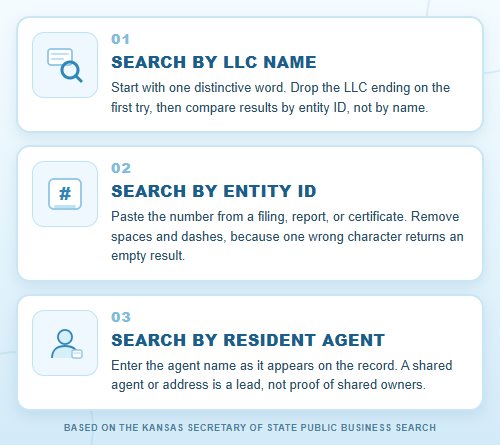
Search by LLC Name
Start with the one word that identifies the company and drop the ending on the first attempt. Kansas stores “LLC”, “L.L.C.”, and “Limited Liability Company” in the name field, but the match treats them unevenly. Drop punctuation, apostrophes, and a leading “The”, then compare the results by entity ID rather than by name.
A generic word returns a long list. Sort by status and formation date, then open the record whose registered office or resident agent matches the business in front of you. Two LLCs with similar names in different counties are usually unrelated, and one of them may be forfeited while the other is active.
Search by Entity ID
The entity ID returns one record when the number is exact. It is printed on the articles of organization acknowledgment, on each information report, and on a certificate of good standing. Paste the number instead of typing it by hand, and strip any spaces or dashes. A single mistyped character yields an empty page that resembles a closed company.
Search by Resident Agent
Kansas builds the index around the entity, so an agent lookup means searching the resident agent name as it appears on the record. A commercial agent appears on hundreds of filings, which makes an agent match a weak signal on its own. Use it to confirm that two companies share an address, not to prove that they share owners.
State index for LLC records:
https://www.sos.ks.gov/eforms/BusinessEntity/Search.aspx
Inside a Kansas LLC Record
The LLC page is compact, and every line answers something specific. Work down the fields rather than jumping to the name, because a similar name is not the same company. Kansas does not publish a full ownership schedule, so the record often names managers and an agent without naming every member.
Name and Designation
The legal name is the one printed on the articles of organization, and it must contain a required designation. The type field separates an LLC from a corporation, a limited partnership, and a nonprofit. That distinction matters because the reporting cycle and the governance rules follow the type.
Entity ID and Formation Date
The entity ID identifies the business and stays with it through a name change, an address change, and a change of agent. Formation is the day the office accepted the articles, and it is rarely the day the owners opened for business. Contract authority, tax periods, and any statement about longevity all hang on that date.
Status
An active LLC is registered and has met its latest reporting duty. A late report moves the company to delinquent while the registration survives; a continued failure lets the state forfeit it, which strips the LLC of its legal existence. Members who vote to wind up the company file a dissolution, and that record closes the file in an orderly way.
Registered Office and Resident Agent
Every Kansas LLC keeps a resident agent with a Kansas street address, and the registered office appears beside the agent name. The agent accepts service of process and official mail. The principal office is the business address on file, which can trail the real office by months.
Members and Managers
Kansas asks for the members or managers of the LLC, depending on how it is governed. A member-managed LLC lists members; a manager-managed LLC may list only its managers. No percentage interest appears on the page, and the filed list is not an ownership schedule. The Kansas registered agent page covers the agent field and the change route.
Filing History
The history lists the articles, information reports, amendments, agent changes, and any dissolution. A gap usually marks a forfeiture and a later reinstatement. A short history on an old LLC raises a question, because documents can be missing or filed under a name the company no longer uses.
The Biennial Report Cycle
Kansas does not require an annual report from an LLC. It requires a biennial information report, due by April 15 in the reporting year, and the report confirms the resident agent, the registered office, and the members or managers. The two-year cycle surprises owners who expect a yearly filing, and a missed report is the most frequent route to forfeiture.
Which Year Applies
The reporting year is set by the state schedule, and the form states the year on its face. A business that files in the wrong year is not credited with the right period. Check the form year before paying, because the state does not apply an early payment to a later cycle.
What the Report Confirms
The report restates the resident agent, the registered office, the principal office, and the members or managers. A change that is not reflected in the report leaves the public record out of date even when the business has moved. File the change first, then the report, so the report confirms the new details.
How a Kansas LLC Is Formed
Formation is one state filing plus a set of decisions the state does not record. The articles create the entity. The operating agreement, the tax election, and the bank account are separate matters that the owners handle without filing them with the Secretary of State.
Name Rules
The name must contain the required LLC wording and must be distinguishable from names already on the register. Kansas compares names after removing punctuation and designations, so “Prairie Home Goods LLC” and “Prairie Home Goods L.L.C.” are treated as the same name. Run a name search before filing rather than after a rejection.
Articles of Organization
The articles are filed through the state portal and must include the LLC name, the resident agent, the registered office, and the principal office. The fee is listed in the table below. Acceptance is the moment the LLC takes effect, and the acknowledgment carries the entity ID to keep on file.
Operating Agreement
An operating agreement sets ownership percentages, voting rules, profit distribution, transfer restrictions, and what happens when a member dies or leaves. Kansas does not require it to be filed, but a bank, a landlord, and a buyer will ask for it. Keep a signed copy with the formation documents and update it when membership changes.
Capital accounts belong in the same document. A member share of profits usually follows the contribution schedule, and a schedule that is never updated becomes a dispute in the second year. Record each contribution when it is made, and have every member sign the update rather than leaving the change in an email thread that a later reader cannot find. A buyer who reads the agreement will ask for those entries before trusting the percentages on the first page.
Closing a Kansas LLC
An LLC closes by filing articles of dissolution after the members approve the decision. The filing ends the registration, and the LLC still has to close its Department of Revenue account and settle its final report. Trading after the articles are accepted leaves the members exposed.
Dissolution is not the same as forfeiture. A voluntary close leaves an orderly file. A state closure interrupts the record and needs a reinstatement to fix. Both stop the business, yet only one carries an interruption that a buyer will question.
Foreign LLCs in Kansas
An out-of-state LLC that wants to trade in Kansas registers as a foreign company, names a Kansas agent, and reports on the state cycle. The record then shows the home jurisdiction and the date Kansas authorized it. The LLC files the Kansas information report on the state schedule.
A foreign LLC that skips the filing can find its Kansas contracts unenforceable. The home-state certificate does not answer the Kansas question, because authority to do business in Kansas is a separate registration with its own entity ID.
What a Kansas LLC Filing Costs
The figures below cover LLC filings and the records that surround them. Kansas charges less for a submission sent through the portal than for one mailed to the office. Rates were reset in a recent revision, so a guide written before that date may quote numbers that no longer apply.
| LLC filing | Fee | Notes |
|---|---|---|
| Articles of organization | $85.00 | Online $85; paper $90 |
| Biennial information report | $90.00 | Portal $90; paper $110 |
Single-Member LLCs in Kansas
Kansas treats a single-member LLC like any other LLC at the state level. The articles name the member or manager, the LLC files the same information report, and the record looks the same as a multi-member record. The difference appears on the federal side, where a single-member LLC is disregarded for income tax by default and reports on the owner return.
A single-member LLC still needs its own bank account and its own records. Commingling personal and business funds is the most frequent reason a court ignores the liability shield, and the state record will not show the problem until a dispute exposes it.
Kansas LLC or Corporation
An LLC is governed by an operating agreement and taxed as a pass-through by default. A corporation is governed by bylaws, issues shares, and is taxed as a separate entity unless it elects pass-through treatment. The state record shows the type, and a buyer should read it before assuming how the company is run.
The formation document and the governance rules differ, but the reporting cycle now follows the same state schedule for both. The Kansas corporation records page covers the corporate side of the registry.
How the Agent Field Changes
The resident agent on the record is a contact point, and it moves when the business moves. Kansas allows the LLC to change its agent and its registered office without refiling the articles, and the change is its own filing. A company that switches to a commercial service shows the service name from that point forward, while older documents keep the previous name.
A resignation leaves a window rather than an immediate gap. The agent files the resignation, the LLC is notified, and a replacement has to be appointed before the state takes action. An LLC that ignores the notice can be forfeited for a reason that has nothing to do with its finances.
Read the agent address with the principal office, not instead of it. The two can sit in different counties, and a mismatch is normal when a service handles legal mail. What matters is that the agent address is a street address that someone still monitors.
Name Changes and Amendments
A legal name change goes in as an amendment, and the state number survives the change, which keeps the filing history and the contracts attached to the entity. The change is separate from an assumed name, which adds a second name rather than replacing the first.
The amendment also handles a change of principal office or a change in the member or manager structure. Each filing has a fee and a short processing window, and the record updates after the office posts the document. A name change does not reset the report cycle.
Tell the bank and the vendors after the state filing. A contract signed under the old name is still enforceable, but a payment sent to an account that still carries the former name can be delayed while the bank asks for the amendment.
Records a Buyer Should Request
A buyer of a Kansas LLC should ask for five documents: the articles of organization, the operating agreement, the most recent information report acknowledgment, a certificate of good standing, and any assumed name filing. Each answers a different question, and a file that holds only the certificate leaves the ownership and authority questions open.
The operating agreement is the document that settles who owns what and who can sign. A bank will ask for it before lending, and a buyer should read it before paying. Where the agreement is missing, the tax returns and the bank records can rebuild most of the picture, but the reconstruction should be disclosed rather than presented as the original.
The report acknowledgment proves the entity is current even when the public record has not updated. Ask for the date on it and compare that date with the certificate. The Kansas business registration page covers the filing that created the record in the first place.
Reinstatement After Forfeiture
Reinstatement restores an LLC that the state closed for a missed report. Kansas wants the skipped reports plus a reinstatement charge, and the company comes back under its original number. The gap stays in the history, so a buyer can see that the business lapsed and recovered.
A reinstated LLC should review its agent appointment and its bank records before trading again. A closure often comes with a stale address or a missed notice, and the same problem can repeat in the next cycle if nobody checks.
Budgeting the First Year
The first year carries the formation fee, the agent cost, and the information report when the cycle arrives. A budget that covers only the filing usually misses the agent and the report, which are the recurring items. Set the report date at formation so the second payment does not arrive by surprise.
An LLC that hires staff or leases space adds tax registrations and local permits, and none of those costs appear on the Secretary of State schedule. A founder who compares only the filing fee will underestimate the first year by a wide margin. Plan three buckets: state filings, agent service, and local requirements.
Keep the receipts together. A lender or a buyer may ask how the formation was funded, and a folder with the acknowledgment, the agent invoice, and the report receipt answers that question in one place.
What the LLC Record Cannot Tell You
The record confirms registration and standing, and it stops there. It does not show ownership percentages, revenue, debts, lawsuits, or tax standing, and it does not confirm that the LLC is insured. An assumed name sits in a separate state filing, and a professional license sits with the board that issues it.
The member field is the most misunderstood part of the record. A name on that line proves that the person was reported to the state, not that the person owns the company or can sign for it. Ask for the operating agreement and a certificate of good standing when authority matters.
Reading an LLC Record for a Vendor Check
For a vendor review, collect the state record, proof of standing, and the assumed name filing if one exists. Start with the status, then read the formation date, then confirm the agent. A company that has been active for years with an agent in the same town is a different risk from one formed weeks ago with an agent that changes every cycle.
Keep a dated copy with the contract. If the LLC is forfeited, ask whether it has been reinstated and when. If it is active but its report is overdue, the next check may show a different status. A dated copy protects you from a change you did not cause.
Frequently Asked Questions
These questions come from owners and from buyers. Every reply names the office or the field behind it.
Is a Kansas LLC search free?
No charge. A name or number lookup needs no account, and the state does not bill for a page view.
What is the difference between an LLC and an assumed name in Kansas?
An LLC is a legal entity created by articles of organization. An assumed name is a second name registered with the Secretary of State, and it does not create an entity.
Can one person own a Kansas LLC?
Yes. One person can hold the entire membership interest and serve as the manager. The filing, the report, and the agent requirement do not change; the operating agreement should still say what happens if the owner dies or sells.
What happens if a Kansas LLC misses its report?
The state can forfeit the LLC. A forfeited LLC cannot sign new contracts in its own name, and reinstatement requires the missing reports and a fee.
Does Kansas require an operating agreement?
No. The state does not require it and does not collect it. Banks, landlords, and buyers usually ask for it, and it is the document that settles ownership and authority when the state record does not.