

Kansas business registration is the filing that creates a legal entity in the state, and it is only one part of what most new owners call registering a business. The Secretary of State creates the LLC, corporation, or partnership. The Department of Revenue issues tax accounts. The federal government issues the employer identification number. Cities and counties add licenses, and regulated trades add credentials from a state board.
This page covers the formation filing, the documents around it, the tax registrations that follow, and the order that keeps the work from repeating. It is written for founders preparing a Kansas filing and for owners moving an out-of-state business into the state. Every charge is listed in the table.
How to Register a Business in Kansas
Registration starts with a name check and a formation filing with the Secretary of State. This Kansas Business Registration guide follows the same order, because the entity ID the filing produces is the number the tax offices, the banks, and the licensing agencies will ask for. Filing the formation document first prevents a later application from being rejected for a missing entity.
Check the Name Before Filing
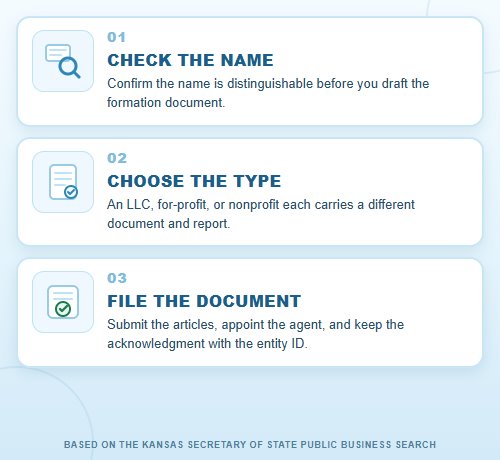
A proposed name must be distinguishable from every name on the state register, and Kansas compares names after ignoring punctuation and designations. Run the search before you draft the articles, because a rejection costs a filing fee and a delay. A reservation holds the name if the formation filing has to wait.
Choose the Entity Type
An LLC suits a small business that wants pass-through tax treatment and a simple governance document. A for-profit corporation suits a business that plans to issue shares or raise outside capital. A nonprofit corporation suits a mission-driven organization that will apply for federal exemption. The type sets the formation document, the report fee, and the tax rules.
File the Formation Document
An LLC files articles of organization. A corporation files articles of incorporation. A nonprofit files articles that state a nonprofit purpose. Each document names the entity, appoints the resident agent, and states the registered office. The fee is listed in the table below, and acceptance produces the entity ID.
Appoint a Resident Agent
Kansas names the role differently from most states, and the appointment sits inside the articles rather than in a stand-alone document. The person or service listed must be reachable at a Kansas street address. Swapping that person later is its own filing, not an edit to the articles.
Kansas business entity search and filings:
https://www.sos.ks.gov/eforms/BusinessEntity/Search.aspx
Papers That Follow the Filing
The state filing creates the entity. The internal documents settle how it is governed, and the state does not collect them. A business that skips them can still trade, but it will struggle at a bank, at a closing, and in a dispute.
Operating Agreement or Bylaws
An LLC adopts an operating agreement. A corporation adopts bylaws and holds an organizational meeting. Both documents set ownership, voting, and authority, and both are requested by banks and buyers. Keep a signed copy with the formation acknowledgment.
Minutes and Resolutions
The organizational meeting appoints the first managers or directors and authorizes the bank account. A resolution that names the account signer is the document a bank will ask for, and it is also the document that proves authority when a contract is challenged. Draft it at formation rather than after the first dispute.
Ownership Records
An LLC records member contributions and percentages in the operating agreement. A corporation records share issuance in a stock ledger. Neither is filed with the state, and both are the first documents a buyer asks for. The Kansas LLC records page shows which of those fields appear in the public record.
Tax Registrations After Formation
A Kansas entity is not automatically registered for tax. The formation filing creates the legal person; the tax accounts are separate applications, and each one carries its own number.
Federal Employer Identification Number
The employer identification number comes from the Internal Revenue Service and is required for a bank account, payroll, and most tax filings. A single-member LLC can use the owner’s social security number in some cases, but the employer number is cleaner and is expected by most banks.
Kansas Sales and Withholding Accounts
The Kansas Department of Revenue issues a sales tax account for businesses that sell taxable goods or services, and a withholding account for businesses that pay employees. A business can hold one without the other. Registering for both when only one applies adds filing obligations the business does not need.
Local Tax and Licensing
Cities and counties may require a local business license, a zoning approval, or a sign permit. A home-based business may need an occupancy approval before it can operate. These are separate from the state filings and often take longer than the formation document.
A regulated trade adds a state credential that the registration does not provide. Contractors, electricians, real estate brokers, and insurance agents each answer to a separate board, and the board sets its own application, fee, and renewal. The registration proves the company exists; the credential proves it may perform the work, and neither substitutes for the other. A business that adds a regulated service later needs the board approval before the first job, even when the company has been registered for years.
What the Timeline Looks Like
An online formation filing is usually reviewed in a few working days, while a mailed package waits in the same queue and adds postage time. The tax accounts can be opened in parallel once the entity exists. Local approvals vary by municipality and can take weeks, which is why a lease should not be signed before the zoning question is answered.
A founder who needs the entity immediately should plan the bank account and the first invoice around the processing time rather than assuming same-day acceptance. The acknowledgment email is the proof the office accepted the filing, and the entity ID on it is what the next applications need.
Registering an Out-of-State Business in Kansas
A business organized in another state that transacts business in Kansas files an application for authority with the Secretary of State. The application names the home jurisdiction, appoints a Kansas resident agent, and states a Kansas registered office. Acceptance produces a separate Kansas entity ID that sits beside the home-state number.
The test is activity, not paperwork. A company with a Kansas office, a Kansas employee, or inventory in a Kansas warehouse is usually transacting business. A company that sells into the state through a marketplace may have a tax obligation without a registration obligation, which is a different question with a different office.
Choosing Between an LLC and a Corporation
The choice is about control and paperwork more than size. An LLC runs on an operating agreement that can be written in plain language, and its owners hold membership interests. A corporation runs on bylaws and a board, and it issues shares. The governance question matters more than the filing fee, because a structure that fits the owners is easier to run.
The number of owners matters less than how they will decide things. A corporation records decisions in board minutes and shareholder votes, while an LLC records them in the operating agreement. Pick the one whose record-keeping the owners will actually keep, because an empty minute book is worse than a simple agreement.
Kansas Registration Fees
Formation charges are listed below. Tax accounts cost nothing to open, and a local license carries whatever the city sets, so neither appears here. Filing through the portal saves a few dollars against the mail price, and the current schedule is the one in force.
| Filing | Fee | Notes |
|---|---|---|
| LLC articles of organization | $85.00 | Portal $85; paper $90 |
| For-profit articles of incorporation | $85.00 | Portal fee $85; paper $90 |
| Nonprofit articles | $20.00 | Online or paper |
What to Do Right After Registration
Open the bank account, adopt the internal documents, and file the first information report when the state cycle opens. Register for the tax accounts that apply, and check whether the city requires a license before the first customer arrives. A business that waits for a notice pays more than one that checks first.
Keep the formation acknowledgment, the entity ID, the employer identification number, and the operating agreement or bylaws in one folder, and review that folder at the end of the first quarter to see what is still missing. Every later application asks for at least two of them, and a folder that is organized once saves hours at a bank, a lender, and a closing.
Tax Elections and the Fiscal Year
An LLC with more than one member is taxed as a partnership by default, and a single-member LLC is disregarded. Either can elect corporate treatment by filing the appropriate form with the Internal Revenue Service. The election changes how the business files, not how Kansas registers it, and the state record still shows an LLC.
A corporation files as its own taxpayer unless it chooses the pass-through route. That choice has eligibility rules and can be revoked. A founder who expects outside investment should decide early, because a later change can disturb the ownership records and the tax filings that came before.
The fiscal year is separate from both. A calendar year is the default, and a different year requires a reason the tax rules accept. The choice affects the reporting calendar only through the state schedule, which is set by the entity type rather than by the tax year.
Hiring the First Employee
Hiring adds obligations that registration does not create on its own. Kansas requires a withholding account, unemployment insurance registration, and workers compensation coverage. The federal government requires the employer identification number, a completed eligibility form for each new hire, and payroll reporting.
Registering for withholding before the first payroll avoids a penalty that appears weeks later. The Department of Revenue publishes the account application and the filing calendar.
Workers compensation is required for most Kansas employers, and a policy is usually the first document a general contractor asks a subcontractor to produce. The requirement applies to the entity even when the owner draws no salary in some cases, so confirm the rule before the first hire.
Insurance, Bonds, and Local Permits
Insurance is a private contract, not a state registration, and no office will confirm that a business carries it. A certificate of insurance is the document a landlord, a client, and a general contractor ask for, and it names the coverage limit and the expiry date. A registered entity without coverage is still exposed to the first claim.
A bond is required for some licensed activities, such as certain contractors and motor vehicle-related businesses. The bond is filed with the licensing agency rather than with the Secretary of State, and it is renewed on its own schedule. A business that treats the bond as a one-time purchase can lose its license at renewal.
Local permits cover zoning, signs, food service, and fire safety. A town can refuse an occupancy permit even when every state credential is in place. Check the local requirements before signing a lease, because a use that is not allowed in the zone cannot be fixed with a state filing.
Changing the Structure Later
An entity can change its type without starting over. Kansas accepts articles of conversion, and the same number carries the contracts and the tax account forward. A conversion is a filing with a fee, not a new formation.
A merger is different. Two entities become one, the surviving company continues under its existing number, and the absorbed company retires from the register. A buyer who checks only the survivor will miss the history of the company that was absorbed, which is why the filing history matters at a closing.
An amendment handles everything smaller than a conversion: a name change, a new share count, a new purpose, or a new office. The Kansas business name page covers the naming side of that filing.
Forming New or Buying an Existing Entity
A shelf company is an entity formed earlier and left inactive. It can be faster than a new filing, but it carries whatever history it accumulated, including old reports, old agents, and old debts. A buyer should read the filing history before paying for the shell, because a clean-looking name can hide a gap.
A new formation is usually cleaner and barely slower. The trade-off is the processing time against the due diligence a shelf company requires. For most small businesses, forming a new entity and reserving the name is the simpler path.
Home-Based and Online Businesses
A business run from a house still needs an entity, a resident agent, and the tax accounts that apply, and it may need a local occupancy approval. Some towns restrict parking, signage, and customer visits in residential zones. A home address can also serve as the registered office, which puts it on a public record unless a commercial agent is used.
An online business with no Kansas location may still have a sales tax obligation once it crosses the state economic threshold. The registration is a tax account rather than an entity filing, and it comes from the Department of Revenue. A marketplace that collects the tax on behalf of the seller changes the filing duty but not the underlying rule.
An owner who lives in another state can still hold a Kansas entity, and the only in-state requirement is a reachable agent address. The arrangement is routine; what changes is the reporting calendar, which now includes a Kansas filing.
Paying the State
Kansas accepts a card through the online portal and a check or money order by mail. A filing that arrives without payment is returned, and a payment that does not match the filing is held until the difference is resolved. Keep the receipt with the acknowledgment, because the two together prove both the filing and the payment.
An expedited option exists for some filings, and it is requested at submission rather than after. A founder with a deadline should confirm the current expedited fee before counting on same-week approval. A refund is requested in writing and is not automatic when a filing is withdrawn.
What Sits in a Registration File
A complete folder holds the state acknowledgment, the signed governance document, the ownership schedule, the federal number, the tax accounts, and the agent consent. Each item answers a question that appears at a bank, a lease, or a sale, and a missing item slows the whole process.
Scan the file and keep a copy outside the office. A fire, a move, or a lost laptop should not take the formation record with it, and a digital copy is accepted by most banks when the original is available on request.
What Registration Does Not Give You
Registration creates the entity; it does not create a license, a tax exemption, or a trademark. A new LLC can be registered and still be unable to open because the town has not approved the use. A nonprofit can be registered and still owe federal income tax until the exemption is granted.
Registration also does not protect a name. The state accepts a name that is distinguishable, and it does not check trademarks. A business that registers a name already used by a national brand can be forced to change it.
What an Owner Should Keep
An owner should keep the formation acknowledgment, the approved articles, the operating agreement or bylaws, the stock ledger or membership schedule, the employer identification number, the tax account numbers, and the first information report acknowledgment. Each one answers a question that will come up at a bank, a lease, or a sale.
A buyer will ask for the same set plus a certificate of good standing. A business that can produce the folder in an hour is easier to sell than one that has to reconstruct it over a month. The Kansas corporation records page shows which of those documents appear in the public record.
Frequently Asked Questions
The questions below come from founders preparing a filing and from owners moving a business into the state. Each reply names the office that handles the answer.
How much does it cost to register a business in Kansas?
The state formation fee is listed in the table above. Tax accounts and local licenses carry separate costs, and a name reservation is optional. The total depends on the entity type and on the city where the business operates.
How long does Kansas take to approve a filing?
An online formation filing is usually processed within a few business days. Paper filings take longer, and local approvals can take weeks. Plan the bank account and the first invoice around that window.
Do I need a resident agent in Kansas?
Yes. Every entity keeps an agent with a Kansas street address. The appointment rides inside the formation document, and a replacement needs its own submission and charge.
Does an LLC need a separate business license in Kansas?
Kansas has no general state business license. A regulated trade needs a credential from its board, and a city or county may require a local license. The entity registration is separate from both.
Can I register a business without a lawyer?
Yes. The filings are designed for direct use, and the state publishes the forms and the fees. A lawyer is useful when the ownership structure, the tax election, or a regulated activity needs advice that a form cannot give.