

A Kansas certificate of good standing is a dated statement from the Secretary of State that a business entity is registered and current with its filing obligations. It is a short document with the state seal, the legal name, the entity ID, and the date of issue. Banks, landlords, lenders, and procurement offices ask for it because it answers the standing question in a form they can verify, and a search result is not a substitute.
This page covers what the certificate says, who asks for one, how to order it, how it differs from a file detail report, and where it stops being useful. It is written for owners responding to a request and for buyers who need a dated answer before signing. Only the table carries charges.
How to Get a Kansas Certificate of Good Standing
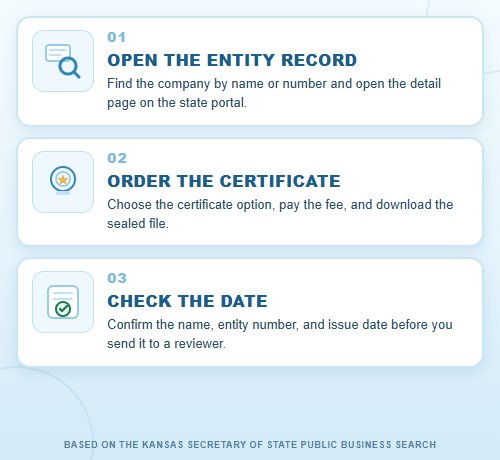
The certificate is ordered through the Secretary of State’s business portal. Open the entity record, select the certificate option, pay the fee, and download the document. The request usually takes minutes, and the file can be printed or emailed as soon as the payment clears.
Start from the Entity Record
Search by name or entity ID, open the detail record, and confirm that the name and the ID match the entity you need. A certificate pulled for a similarly named company is a frequent and embarrassing error, and the name on the certificate is what the bank will compare with the contract.
Pay and Download
Kansas charges a flat fee for the certificate, listed in the table below. The portal accepts a card, and the document arrives as a printable file. Save the order confirmation with the certificate, because a later reader may want to verify where the document came from.
Check the Date and the Name
The issue date is the part that matters most. A certificate speaks only to the day it was issued, and a bank may require one that is less than thirty or sixty days old. Check the legal name, the entity ID, and the date before you send it, and reorder rather than editing a stale copy.
Order the sealed document from the entity record:
https://www.sos.ks.gov/eforms/BusinessEntity/Search.aspx
Certificate Wording
The wording is short and specific. The certificate states that the entity is organized under Kansas law, that it is in existence on the date shown, and that it has filed the reports and paid the fees required to remain in good standing. It carries the state seal and the signature of the Secretary of State.
It does not state that the business is profitable, insured, licensed, or free of liens. It does not list the owners, and it does not confirm that the person holding it is authorized to act for the company. Those questions belong to other documents and other offices.
Active Versus in Good Standing
An entity can be active and still not be in good standing. Active means the registration exists. Good standing means the entity has met its filing and payment obligations. A certificate turns the second statement into something a third party can rely on, which is why a search printout with an active status is not always enough.
Who Asks for the Certificate
The request usually comes from an institution that has to document its own file. Each one has a reason, and the reason is why a screenshot will not do.
Banks and Lenders
A bank opening an account or a lender closing a loan wants proof that the borrower exists and is current. The certificate goes into the credit file, and the date on it is recorded. A certificate that names a different entity than the account holder will stop the process.
Landlords and Property Managers
A commercial lease often names the legal entity rather than the brand. The landlord asks for a certificate to confirm that the tenant exists and that the signer represents the entity. A tenant that cannot produce one may be asked for a personal guarantee instead.
Licensing Agencies
Some license applications require a certificate of good standing as part of the package. The agency wants to know that the applicant is a registered business before it issues a credential. The certificate does not replace the license, and the license does not replace the certificate.
Procurement and Large Contracts
A public body or a large buyer often requires a certificate before it will award a contract. The document is part of the vendor file, and it is usually refreshed before each renewal. A vendor that lets the certificate lapse can lose an approved status without any change to the underlying business.
Certificate Versus Detail Report
The detail report is the full record: the name, the entity ID, the status, the agent, the office, the officers or members, and the filing history. The certificate is a short statement about standing. One is a research document and the other is an attestation, and they answer different questions.
A buyer running diligence wants the report plus the certificate. The report shows what the state holds. The certificate shows that the state considers the entity current on the date of issue. A file that contains only one of them leaves a gap that a careful reviewer will notice.
Verifying a Certificate
A certificate can be checked against the live record. Compare the legal name, the entity ID, and the issue date with the portal, and confirm that the status still reads active. A document that does not match the current record is either old or altered, and both are reasons to ask for a fresh copy.
A photocopy is easy to edit, which is why some institutions ask for the original file or a verification from the portal. A certificate sent by email is usually accepted when the sender is the business itself and the file matches the record. A certificate forwarded by a third party deserves a second look.
Some institutions ask the office to confirm a certificate directly rather than accepting a copy. That request is separate from the order, and it can take longer than the download. Ask the reviewer whether a portal printout with a timestamp will do, because a printout can be produced the same day and answers the same question for many files. If the answer is no, start the confirmation early, since the reply arrives on the office schedule rather than yours.
Kansas Certificate and Copy Fees
Charges for certificates and certified copies are listed below. A certificate ordered through the portal costs less than a mailed request. The state reset these amounts in its latest revision, so confirm the total at checkout.
| Document | Fee | Notes |
|---|---|---|
| Certificate of good standing | $10.00 | Portal $10; mail $15 |
| Certified copy of a filing | $15.00 | Per document |
Other Documents the Office Issues
The certificate is one of several documents the Business Services Division produces, and the request is often confused with the others. The wording differs, the fee differs, and a reviewer who asked for one will usually reject the substitute. Ask which document the file requires before placing the order.
Certificate of Good Standing
This is the short attestation described on this page. It states that the entity exists and is current, and it carries the seal and the issue date. It is the document a bank and a landlord mean when they ask for proof of standing.
Certificate of Existence
Some states issue a certificate of existence for the same purpose, and Kansas wording follows the request. An existence certificate confirms that the entity is on the register on the date shown without speaking to the filing history behind it. Where a counterparty names a specific title, order the title it names rather than an equivalent.
Certified Copy of a Filing
A certified copy reproduces a filed document, such as the articles or an amendment, with the state seal attached. It is used to prove what the document said, not whether the entity is current. A closing that needs both facts needs both documents.
Plain Copy
A plain copy carries no certification and proves nothing on its own. It is useful for internal records and for a file that already holds a certified version. Ordering a plain copy when a certified copy was requested is a frequent reason a package is returned.
Ordering by Mail
The online portal is the faster route, and the mail route still exists for owners who cannot pay by card or who need a sealed paper original. The paper request uses the state form, a check or money order, and a self-addressed envelope. The fee is higher than the online price, which reflects the manual handling rather than the document.
The Paper Form
The form asks for the entity name, the entity ID, the document requested, and the return address. Copy the legal name from the record rather than from a website, because a mismatch sends the request back. Note the quantity when more than one sealed copy is needed for a closing with several participants.
Payment by Check
The office accepts a check or a money order made payable to the Secretary of State. A card is not accepted on the paper route. Write the entity ID on the memo line so the payment can be matched to the request when the envelope is opened.
The Return Envelope
A self-addressed stamped envelope speeds the return and removes a stage at the office. Without one, the document comes back by ordinary mail and the delivery date is harder to predict. A closing with a fixed date should use the online route or allow extra days for the mail.
Standing for a Foreign Entity
An out-of-state company registered in Kansas can order a Kansas certificate, and it will describe the Kansas registration rather than the home-state record. A lender that wants the full picture asks for both certificates, because each one speaks only to its own state. The Kansas corporation records page shows how the home jurisdiction appears on a Kansas record.
The Kansas certificate shows the date the authority began and the current status of the Kansas registration. It does not confirm that the company is current in its home state, and a lapse there can affect the Kansas filing later. Order the home-state certificate from the home office and keep the two documents together.
A foreign entity that lets its Kansas registration lapse can still be current at home. The reverse is also true. A buyer checking a vendor with offices in several states should collect a certificate from each state where the contract will be performed.
When the Office Cannot Issue the Certificate
The portal will not issue a certificate for an entity that is not in good standing. A forfeited or dissolved record produces an error rather than a document, and the fix is to restore the registration before ordering again. The error is a useful signal, because it confirms the problem before a lender finds it.
A business that receives that message should read the filing history and identify the missing report. Reinstatement clears the record, and the certificate can be ordered as soon as the reinstatement posts. A request made during the gap returns the same error, which is why the sequence matters.
A dissolved entity cannot be restored by reinstatement in the ordinary sense. The owners either form a new entity or, where the state allows, withdraw the dissolution. Either route takes longer than the report that was missed, and both should be discussed with the office before a closing date is set.
Certificates for Several Entities
A parent company with several subsidiaries often needs a certificate for each one. The portal handles them one at a time, and each order produces a separate document with its own date. A file that holds one certificate for a group of companies leaves the other entities unproven.
Build a short schedule with the legal name and the entity ID for every company in the group, then order against that list. The schedule doubles as the index for the closing file, and it prevents the usual error in a group request, which is a certificate pulled for the parent when the contract names the subsidiary.
Note the order dates on the schedule as the certificates arrive. A group file with dates beside each name is easy to refresh at the next renewal, and it shows a reviewer that the entities were checked as a set rather than one at a time.
Losing Standing and Restoring It
An entity loses good standing when a required report or fee is missed. The status may still read active for a period, which is why the certificate is the document that settles the question. Once the state forfeits the registration, the entity can no longer sign new contracts in its own name until it is reinstated.
Restoration usually requires the missing reports, the fees that were due, and a current Kansas registered agent who still accepts mail. The certificate can be ordered again after the office posts the reinstatement, and the new certificate will show the current date. A buyer should ask for the reinstatement date as well, because the record keeps both events.
How Long a Certificate Stays Useful
A certificate has no fixed expiry, but most institutions treat it as current for thirty to ninety days. A bank may require a fresh one at closing, and a public body may require one with each annual renewal. The date on the document is what the reviewer reads, so a certificate from last year is often treated as no certificate at all.
A business that expects several requests in a quarter should order one certificate at the start of the process and keep the entity ID handy. Reordering is cheap and fast, and a fresh date avoids a delay at the counter.
What the Certificate Does Not Prove
The certificate proves registration and standing on a date. It does not prove ownership, authority, insurance, licensure, tax compliance, or creditworthiness. A business can hold a clean certificate and still carry a judgment, a lien, and a lapsed professional license.
The document also does not confirm that the person presenting it works for the company. A certificate is a public document, and anyone can order one for any entity. Authority comes from the operating agreement, the bylaws, or a resolution, and those are the documents to request when a signature matters.
Using the Certificate in a Vendor File
A vendor file should hold the certificate, the detail report, and the document that proves the signer authority. The certificate answers the standing question, the report answers the structure question, and the resolution answers the signature question. Together they cover the three things a contract review asks.
Refresh the certificate before each renewal and note the date in the file. A vendor that was current at onboarding can lose standing a year later without any change to the relationship. The Kansas business status page covers the status field that turns a certificate into a decision.
Certificates for Use Outside Kansas
A business that needs the certificate in another country usually needs an apostille or a certification attached. The Secretary of State authenticates the document, and the requesting country may require a further stage through its own embassy or a designated authority. Order the certificate first and ask about authentication before you send it abroad.
A plain certificate is not accepted for an international filing. The authentication is a separate process with its own fee and timeline, and it can add days to a closing. A business that plans to use the certificate overseas should start the request early rather than on the day of the signing.
When the Certificate Is Lost
A lost certificate is not a disaster. The portal keeps the order record, and a replacement can be ordered for the same fee as the original. The replacement carries a new date, which is usually an improvement for a bank that wants a current document.
Keep the replacement with the order confirmation and note why it was reordered. A file that shows two certificates with different dates is normal when a closing slipped, and a short note records the sequence for a later reviewer.
Frequently Asked Questions
The questions below come from owners responding to a document request and from buyers checking a vendor. Each answer names the office or the document that settles it.
How much does a Kansas certificate of good standing cost?
The state fee is listed in the table above. Authentication for use abroad is a separate charge, and a certified copy of a filing is priced separately as well.
How long does it take to get the certificate?
Usually minutes. The portal issues the document after payment clears, and it can be printed or emailed immediately. A request that needs authentication takes longer.
What is the difference between good standing and active?
The two labels answer different questions. A search result can show the entity as active while a report is still in process, and a certificate ordered during that window states the standing position more cautiously. Order the certificate when a reviewer needs the distinction in writing.
Can I get a certificate for an LLC?
Yes. The certificate is available for LLCs, corporations, nonprofits, and the partnership forms. The wording adjusts to the entity type, and the fee is the same.
Does the certificate expire?
It has no formal expiry, but most institutions treat it as current for a limited period. Keep the most recent copy on file and order a new one when a reviewer asks for a current date.