

Kansas business status search answers the question a contract, a loan, or a lease usually turns on: is this entity still legally alive, and is it current with the state? The status sits beside every result in the business entity search and again at the top of each record. One value on that page decides whether a contract can be signed in the entity name.
This page covers each status value, the difference between active and in good standing, how a status changes, the reinstatement route, and what a buyer should do with the answer. It is written for owners checking their own record and for anyone who needs to know whether a company can sign a contract today. Amounts are kept in the table.
How to Check a Kansas Business Status
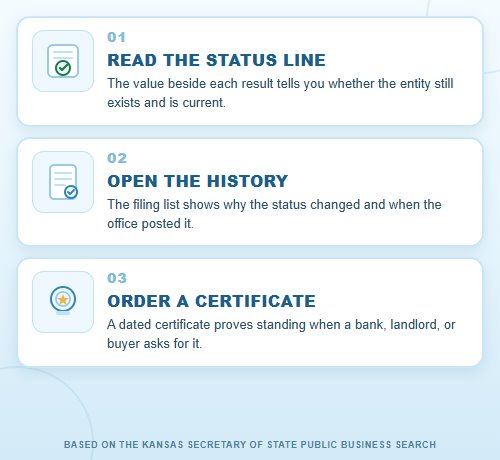
The business entity search returns the status beside every result and again on the detail record. This Kansas Business Status Search reads that line with its date, because a record can change between the day you check and the day you sign. Search by name or entity ID, open the record, and note what the value was on the day of the check.
Read the Status Before the Name
A result list sorted by relevance puts similar names together, and the status column is the fastest way to discard closed entities. Open only the active records, then confirm the entity ID and the formation date before you accept a match. A closed record with a familiar name is a frequent source of confusion.
Check the Filing History Behind the Status
A status is a conclusion drawn from the filings. A forfeited record usually shows a missing information report, and a reinstated record shows the gap plus a reinstatement entry. Open the history when the status does not match what the business claims, because the documents set out the sequence.
Order a Certificate for a Dated Answer
A search page is a snapshot that anyone can refresh. A certificate of good standing is a dated document that a bank, a landlord, or a procurement office will accept. Order the certificate when the answer has to survive a review, and keep it with the contract.
Current status and standing:
https://www.sos.ks.gov/eforms/BusinessEntity/Search.aspx
Kansas Status Values
Kansas uses a small set of values, and each one tells you whether the entity exists and why it stopped. The label appears on the record and on the certificates the state issues, so the same words show up in contracts, loan files, and court papers.
| Status | What it means | What the entity can do |
|---|---|---|
| Active | Registered and current on its reporting duties | Sign contracts, hold assets, and sue in its own name |
| Delinquent | A required report is late | Still exists; file the report to clear it |
| Forfeited | Closed by the state after a missed report | Nothing until reinstated |
| Dissolved | Closed by its owners | Wind up only, no new business |
Active
Active means the entity is registered and current on its information report. It does not mean the business is profitable, insured, licensed, or tax compliant. A company can be active with an unpaid tax account, a lapsed license, and a judgment against it, because the registry tracks filings rather than money.
Delinquent
Delinquent is the warning stage. The report is late, and the state has opened a window in which the business can still file without losing its registration. A business in that window should file immediately rather than wait for a notice, because the next stage is forfeiture.
Forfeited
Forfeiture is the state withdrawal of the registration after a missed report. The entity loses its existence, cannot sign new contracts in its own name, and may still owe the reports for the periods it skipped. Reinstatement is possible, but the record keeps the gap.
Dissolved
Voluntary dissolution is a decision by the owners. The filing leaves an orderly record, and the business winds up its affairs, pays its debts, and distributes what remains. A dissolved entity can still be sued for acts that happened before the closure.
Active Is Not the Same as in Good Standing
Active describes the registration. Good standing is a statement that the entity is current, and in Kansas that statement comes from a certificate of good standing rather than a search result. A record can be active while a report is in process, and a certificate issued during that window may say something the search page does not.
The certificate is dated and can be ordered through the same portal. A bank that asks for proof does not want a printout, because a printout has no attestation and no date the bank can verify. The Kansas certificate of good standing page covers the wording and the ordering route.
How a Status Changes
A status changes when a filing is processed. An information report keeps an entity active, a missed report moves it to delinquent and then to forfeited, a reinstatement returns it to active, and a dissolution closes it. The record updates when the office posts the document, which can lag the filing date by a few days.
The Biennial Report Cycle
The report lands on a two-year cycle, and the due date is April 15 of the filing year. The cycle is set by the state schedule rather than by the formation date, so two entities formed a month apart can file in the same year. A missed report is easier to prevent than to fix, and the fix costs a reinstatement fee on top of the overdue reports.
Reinstatement
Reinstatement restores an entity after the missing reports are filed. Kansas requires the overdue reports and a reinstatement fee, and the entity returns with the same ID. That continuity keeps the contracts and the tax identity attached to the same legal person.
Voluntary Dissolution
Closing on purpose takes a filing too. The owners vote, the articles of dissolution go to the office, and the company winds up: the tax account closes, the final report goes in, and what remains is distributed. A balance left open can follow the owners after the entity is gone.
Reinstatement in Detail
Reinstatement is available for most forfeited entities, and it is usually the fastest way to restore a business that lost its status by accident. The application asks for the entity information, the missing reports, and the fees that were due. The state reviews the package and returns the entity to active status.
The record keeps the gap. A buyer who checks the filing history will see the forfeiture and the reinstatement, and the gap can raise questions about contracts signed during that period. If the entity signed while forfeited, the owners may face personal exposure, which is one reason to file before the deadline rather than after a notice.
Kansas Status and Filing Fees
The charges below relate to the filings that shift an entity between statuses. Electronic submission costs less than paper for the report. Because the schedule changed recently, confirm the amount on the form before you pay.
| Filing | Fee | Notes |
|---|---|---|
| Biennial information report, LLC | $90.00 | Portal $90; mail $110 |
| Biennial information report, corporation | $90.00 | Online $90; mail $110 |
| Reinstatement | $35.00 | Plus overdue reports |
Status and the Filing History
Every status change leaves a document behind. A forfeiture follows a missing report, a reinstatement follows an application, and a voluntary close follows a filing. The history lists those documents in order, which lets a buyer reconstruct what happened without calling the business. Sequence is the part a single status word cannot show.
A record with a clean history and an active status is easy to accept. A record with a forfeiture, a reinstatement, and a recent agent change is not automatically bad, but it deserves a question. The Kansas registered agent page shows how the agent field reads when the appointment changes.
Status and the Registered Agent
The agent field can change a status without any financial problem on the business side. A resident agent who resigns leaves the entity without a valid appointment, and the state can act when a replacement is not filed. A business that ignores the notice can lose its registration for a reason that has nothing to do with revenue or reporting.
A change of agent is a separate filing with a low state fee, and it takes effect when accepted. The new agent must consent, and the office must be a physical location in the state. A stale address is the most frequent reason a business misses a notice, and a missed notice is the usual route to a status change.
Check the agent address at the same time as the status. A business with an active status and an agent address that no longer exists can still be served, but only on paper. That check takes seconds and saves a costly reopening later.
What a Lender Reads
A lender reads the status as part of the credit file. An active record supports the certificate of good standing, and a gap in the history invites a question. The lender also checks the officers against the signer on the note, because a signature from someone who is not on the record needs a resolution.
A record that was active at application and forfeited at closing is a red flag, even when the change is a routine report. Some lenders require the certificate to be issued within a few days of funding for that reason. A borrower who expects a closing should order the certificate after the last report posts.
The lender may also ask for the report acknowledgment when the public record has not updated. The acknowledgment resolves the timing question, and a lender that accepts it will usually proceed. A borrower who cannot produce one may be asked to wait for the record to update.
How Long a Status Change Takes
An online filing usually posts within a few business days, and a paper filing takes longer. A reinstatement can take more time than a routine report because the office reviews the package. The status on the search page can therefore lag the filing date by a short window.
A duplicate filing made during the gap creates a second receipt and a second fee, which is harder to unwind than a short wait. The acknowledgment is the proof that the first filing was received, and it is the document the office will ask for if the record does not update.
If the gap runs longer than a week, call the Business Services Division with the entity ID and the filing date rather than filing again. A printed receipt settles the date question faster than a phone call. The call takes minutes and usually resolves the question without a second payment.
Status and the Reporting Calendar
The information report is the filing that keeps a Kansas entity in good standing. The Kansas business registration page covers the formation filing that created the record, and the report cycle starts from there.
Put the reporting year and the April deadline in the same calendar as the tax returns. A single page with the dates prevents the most frequent late filing, which is the one nobody remembered to list.
When a Status Looks Wrong
A business sometimes reports an active status that the record does not show. The usual reasons are a different legal entity, a recently filed report that has not posted, or a forfeiture the owners never noticed. Ask for the entity ID and the filing confirmation before accepting the claim.
A parent company and a subsidiary are the most frequent source of confusion. The parent may be active while the subsidiary that signed the contract is forfeited, and the brand name on the website belongs to neither record. Match the entity on the signature block to the entity on the certificate.
If the record shows a forfeiture the owners dispute, ask when the report was filed and for the acknowledgment. A payment that was reversed, or a report filed under a former name, can leave the entity forfeited even though the owner believes the filing was complete.
The filing history shows what the state actually received, and it is the document to read before calling the office. A call that begins with the entity ID and the filing date resolves most of these questions in minutes.
What the Status Cannot Tell You
The status does not report tax standing, license standing, insurance, credit, or litigation. A business can be active and owe the Department of Revenue a balance, or hold an active registration and a suspended license. Each of those questions needs a separate search with the agency that holds the record.
The status is also a snapshot. It changes when a filing is processed, and a record that is active today can be forfeited next month. A dated copy is the only proof of what the state held on a specific day, and the date belongs in the contract file.
A Short Status Check for Contracts
A practical check takes a few minutes and covers the questions a contract raises. Confirm the entity is active, confirm the agent is current, confirm the name matches the contract, and order a certificate if the deal is large enough to justify one.
- Status. Active, not forfeited, dissolved, or delinquent.
- Agent. A street address in Kansas that still receives mail.
- Name. The legal name matches the signature block.
- Authority. The signer is an officer, manager, or member with authority.
- Date. The record was checked on the day of signing.
What a Status Change Costs a Business
A forfeited entity loses more than a label. The bank may freeze the account when it learns of the change, the landlord may ask for a personal guarantee, and a customer may pause a purchase order until the record clears. The reinstatement fee is the smallest part of the bill, because the interruption is what costs money.
A business that discovers the problem early can often fix it in days. A business that discovers it during a closing may lose the deal, since a lender will not fund a borrower that cannot show a current registration. The difference between the two outcomes is usually the calendar, not the paperwork.
Status and the Tax Account
The business registration and the tax account are separate records, and one can be current while the other is not. A company that files its information report on time can still have a closed sales tax account, and a company with a clean tax account can be forfeited for a missed report.
The Department of Revenue does not restore an entity, and the Secretary of State does not restore a tax account. A business that wants to trade again has to fix both, and the order matters when a bank asks for proof. Restore the entity first, then the tax account, then the certificate.
A lender reads the two records as one file. The tax account shows whether returns are current, and the entity record shows whether the registration survives. A letter from one office that names only its own account will usually be returned with a request for the other. Ask each office for a dated confirmation that names the entity and the account, and send both together rather than describing the gap in an email. Keep the two confirmations in the same folder, because a reviewer will compare the dates and the account numbers on both. A short cover note that lists both dates helps.
Status in a Sale or Merger
A seller that is forfeited cannot transfer assets in the entity name, which stops a deal before the closing. The buyer should check the status weeks before signing rather than on the closing date, because reinstatement adds days and the closing calendar rarely has room for them.
A merger retires the entity ID of the disappearing company and keeps the survivor in place. A buyer should confirm which entity holds the contracts and the licenses, because the familiar name may belong to the entity that was absorbed. The filing history on the survivor shows the transaction date.
Frequently Asked Questions
Owners and buyers send these questions most often. Each reply names the office or the document that settles it.
What does forfeited mean in Kansas?
The state closed the entity after a missed information report. The business loses its legal existence and cannot sign new contracts until it is reinstated. The record keeps the forfeiture even after reinstatement.
How do I check if a Kansas business is in good standing?
Search the record and read the status, then order a certificate of good standing for a dated answer. The certificate is what a bank or a landlord accepts, and it reflects the position on the day it was issued.
Can a forfeited Kansas business be reinstated?
Yes, in most cases. The application requires the missing information reports and the reinstatement fee. The entity returns with the same ID, and the record shows the forfeiture and the reinstatement.
What is the difference between dissolved and forfeited?
A voluntary dissolution follows a decision by the owners. A forfeiture follows state action, usually for a missed filing. Both stop the business from signing new contracts, but only the forfeiture leaves a compliance gap.
Does active status mean a business is licensed?
No. The status covers the business registration only. A professional credential is issued by a separate board, and a business can hold an active registration with a suspended license.