

Kansas registered agent search is a lookup of the name and street address that a business reports as the place where lawsuits and official mail are served. Kansas calls the role a resident agent, and every LLC, corporation, nonprofit, and partnership registered in the state must keep one. The appointment is part of the formation document rather than a separate record, and it appears on the public record with the registered office.
This page covers what the role requires, how to find an agent from an entity record, what a change of agent involves, and why the field matters in a contract or a dispute. It is written for owners appointing an agent and for buyers checking whether a company can be served. Prices stay in the table.
How to Search a Kansas Registered Agent
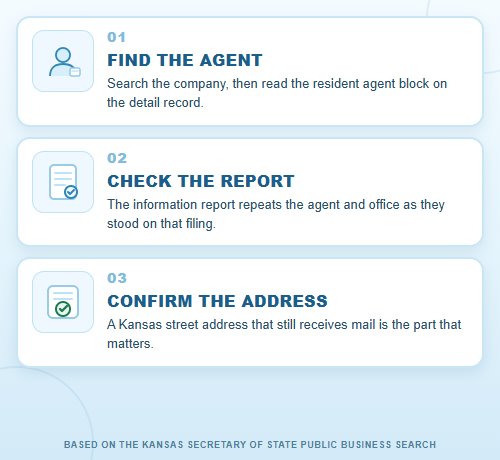
The business entity search is built around the entity, not the agent, so an agent lookup starts with the company name or the entity ID. This Kansas Registered Agent Search begins there, then reads the resident agent block, which lists the agent name and the registered office address where service is accepted. The same block appears on the formation document and on each information report.
Find the Agent from an Entity Record
Search the entity by name or entity ID, then read the agent block near the top of the record. The block shows the agent name and the registered office address. A business that uses a commercial service shows the service name rather than an owner, which is normal and does not indicate a problem.
Find the Agent from a Report
The information report confirms the agent and the office, and the acknowledgment repeats both. If a business has changed agents since its last report, the current record shows the new agent while an older report shows the previous one. Compare the dates before you rely on either.
Confirm the Agent Is Current
A name on the record proves that the agent was reported to the state, not that the agent still accepts service. A commercial service that closed an office, or an individual who moved, can leave a stale appointment on file. The address is the part to check, because a street address that no longer exists is the clearest sign of a problem.
Search Commercial Agents by Name
A commercial agent appears on hundreds of records, and the search returns each entity separately. Searching the name of the agent company in the entity index shows its own record, which confirms that the agent is registered to transact business in Kansas. That check is useful when an unfamiliar service appears on a vendor record.
Resident agent details on each filing:
https://www.sos.ks.gov/eforms/BusinessEntity/Search.aspx
The Resident Agent Role
The agent accepts service of process, which is the legal delivery of a lawsuit or a subpoena, and receives official mail from the state. The agent then forwards the documents to the business. The role is administrative: the agent does not run the company, does not own a share, and does not make decisions for it.
Service of Process
When someone sues a Kansas business, the plaintiff serves the resident agent rather than chasing an owner. Service on the agent is legally effective even if the owner never sees the papers, which is why a stale agent is dangerous. A default judgment can follow a lawsuit the owner never knew about because the papers went to an address nobody monitored.
Official Mail
The state sends report reminders, notices of delinquency, and other official correspondence to the agent and to the business account. A missed reminder is the usual path to forfeiture, and a forfeited business loses its legal existence until it is reinstated.
Consent to Serve
The agent must consent to the appointment, and the consent is part of the filing. An agent who never agreed can resign, and a resignation is a filing with the state that leaves the business without a valid agent. The business then has a window to appoint a replacement before the state takes action.
Kansas Agent Requirements
Kansas requires a physical street address in the state. A post office box does not satisfy the requirement, and neither does an address outside Kansas. The agent must be available during normal business hours, because service can arrive at any time the office is open.
Who Can Serve
An individual who resides in Kansas can serve as an agent for a business they own or for another business that appoints them. A business entity authorized to transact business in Kansas can also serve, and most commercial services are organized this way. The entity must be in good standing itself, which is why a service with a forfeited registration is a poor choice.
One Agent, Many Entities
A single agent can serve many businesses, and a commercial service often serves thousands. Sharing an agent does not create a relationship between the businesses, and two companies with the same agent are not affiliated. The agent field is a contact point, not a statement about ownership. Two competitors can share the same service, and the shared appointment says nothing about a connection between them.
Agent Address Versus Business Address
The agent address is where legal papers go. The principal office is where the business says it operates. The two can be the same for a small company working from one location, and they are usually different for a company that uses a service. Confusing them sends mail to the wrong place and makes a record look inconsistent when it is not.
Changing a Resident Agent
A business changes its agent by filing a change with the Secretary of State. The filing names the new agent, includes the consent, and takes effect when accepted. Kansas does not charge a large state fee for the change, and the portal adds an access charge at checkout.
What Triggers a Change
A move, a sale of the business, a switch to a commercial service, or the resignation of an individual agent all trigger a change. A business that moves its office without updating the agent address can end up with an agent address that no longer receives mail, which is the same as having no agent at all.
Resignation by the Agent
An agent can resign by filing a resignation with the state and notifying the business. The resignation does not take effect immediately, and the business has a window to appoint a replacement. A business that ignores the notice can be forfeited, which is a harder problem than a routine agent change.
Cost and Timing
The filing is inexpensive compared with the cost of a missed lawsuit, and it is processed in the order received. The acknowledgment arrives as soon as the payment clears, and the record shows the new name once the office posts it. A change made before the report is due should be filed first, so the report confirms the new agent.
Privacy and the Agent Address
A resident agent address is public. An owner who does not want a home address on the record can use a commercial agent, which puts the service address in the public field instead. That choice does not hide ownership from a court, but it does keep a home address out of a routine search.
An owner who uses a home address should consider what a public record means over time. The address stays on the filing history even after a move, and a data broker can collect it years later. A commercial agent avoids that exposure for a modest annual fee, and it separates the business address from the owner address in a way that survives a move.
Ask a prospective agent what happens after a delivery. A staffed desk can accept a hand-delivered envelope and timestamp it, while a mailbox may refuse one, and the difference appears only when a claim is filed. Put the answer in the signed agreement, along with the hours the desk is open and the address that will appear on the record. A service that cannot describe its own intake in one sentence is not ready to accept process for anyone. Review the appointment once a year, before the renewal invoice arrives, because a service can close an office without telling every client.
Service of Process in Practice
Service on the agent starts the clock on a lawsuit. The agent forwards the papers, and the business has a fixed time to respond. A business that never receives the papers because the agent address is stale can lose by default, and a default judgment is difficult and expensive to reopen.
The plaintiff does not have to find an owner or a manager. Service on the resident agent is enough, which is why the agent must be reachable and why the address must be current. A business that treats the agent as a formality is taking a risk it does not need to take.
Using a Commercial Registered Agent
A commercial service charges an annual fee and provides a street address, a scanning and forwarding service, and a reminder when a filing is due. It also provides continuity when an owner moves, which is the main reason businesses switch from an individual to a service.
The cost of a service is usually small compared with the cost of a missed notice. A service that forwards documents by email the same day is worth more than one that holds paper for a week, because the response deadline does not wait for the mail. Ask how the service handles service of process before you appoint it.
Kansas Agent and Filing Fees
The figures below cover agent changes and the records around them. The online price is lower than the paper price on an agent change. Confirm each figure before filing, since the schedule was revised recently.
| Agent item | Fee | Notes |
|---|---|---|
| Change of resident agent | $30.00 | Portal $30; mail $35 |
| Biennial information report | $90.00 | Online $90; mail $110 |
Checking an Agent in a Contract
An agent check answers one question: can this business be served? A vendor with a commercial agent and a valid address is easier to sue than one with an individual agent who moved two years ago. That does not make the vendor honest, but it does make a dispute resolvable.
Read the agent field together with the principal office and the status. A business with an active status, a current agent, and a principal office that matches its website is a normal record. A business with a stale agent, a forfeited status, and a principal office that is a mailbox is a record that needs questions before a contract.
Keep a dated copy of the record with the contract. The Kansas business status page shows how the status field reads, and an LLC record shows where the agent block sits.
What the Agent Field Says About a Vendor
The field answers a narrow question, and it answers it well. A vendor with a current agent and a street address can be served; a vendor with a stale appointment cannot, at least not without extra work. That difference matters most when a dispute is already likely, because service is the first stage in any claim.
Read the field with the status and the principal office. A record that shows an active status, a service address, and an office that matches the website is a normal file. A record that shows a forfeited status, an agent who moved, and a mailbox for an office is a file that needs answers before a payment.
For a corporation, the same block appears on the corporate record at the top of the page. The wording changes with the entity type; the purpose does not.
Agent Changes During a Sale
A sale of a business often includes a change of agent, because the buyer wants a contact point it controls. The change should be filed at closing or immediately after, and the seller should confirm that the resignation and the new appointment do not leave a gap. A gap of even a few weeks can produce a missed notice.
A buyer that purchases assets rather than the entity may form a new company and appoint its own agent, which avoids the question entirely. A buyer that purchases the entity inherits the appointment and should change it as part of the closing checklist.
The filing history shows both the old and the new appointment, which is useful when a contract signed before the sale names the former agent. Keep the change acknowledgment with the closing file so a later reader can trace the sequence.
When the Address Is a Mailbox
A commercial mail service is not the same as a registered office. Kansas expects a physical street address where a process server can deliver documents, and a mailbox store may not satisfy that test in a dispute. A business that uses a mailbox for convenience should confirm that the address is acceptable before relying on it.
The practical check is simple: could someone hand a envelope to a person at that address during business hours? If the answer is no, the appointment is weak. A commercial agent with a staffed office avoids the question entirely.
What the Agent Record Cannot Tell You
The agent field does not show ownership, authority, or financial standing. An agent can be a stranger who agreed to accept mail, and the appointment says nothing about who controls the company. It also does not prove that the agent is still in business, because the state does not verify the address on a schedule.
The field is a contact point, and the record is only as current as the last filing. A change of address that was never filed does not appear, and a service that closed an office may still be listed. Treat the agent as a lead, confirm the address, and keep a dated copy of the record.
Agents and Out-of-State Owners
Kansas does not require an owner to live in the state, but it does require an agent who does. An out-of-state owner can form a Kansas LLC, hold the membership interest, and run the business from another state, provided the agent has a Kansas street address. That structure is ordinary and does not change the liability treatment by itself.
The agent field is often the only Kansas address on the record, which makes it the practical contact point for the state and for a plaintiff. An owner who uses a home address as the agent address puts that address on a public record. A commercial service avoids that exposure without hiding the ownership from a court.
What a Service Package Looks Like
A service package usually contains a summons, a complaint, and an affidavit of service. The agent signs for the envelope, records the date, and forwards the set to the business. The date on the affidavit is the date that starts the response clock, not the date the owner opens the envelope.
A business that receives a package should note the court, the case number, and the deadline before anything else. The deadline is usually counted in days, and a weekend or a holiday can shorten the effective time. A call to a lawyer on the day of delivery is cheaper than a motion to reopen a default.
Choosing an Agent for a New Business
A new business picks an agent at formation, and the choice is part of the articles. An owner who plans to move within a year should start with a commercial service rather than a home address, because the change filing costs time and the address on the record follows the appointment.
A business with several owners should name a service or a neutral individual rather than one owner. Naming one owner creates a single point of failure if that person travels, moves, or leaves the company. A service keeps the appointment stable through ownership changes. The Kansas business registration page covers the filing that names the first agent.
Frequently Asked Questions
The questions below come from owners appointing an agent and from buyers checking whether a business can be served. Each answer identifies the field or the office involved.
Does Kansas require a resident agent?
Yes. Every LLC, corporation, nonprofit, and partnership must keep a resident agent with a Kansas street address. The appointment is part of the formation filing, and a change is a separate filing.
Can I be my own resident agent in Kansas?
Yes, if you reside in Kansas and have a street address in the state. An owner who lives out of state cannot serve and must appoint a resident individual or a registered business entity.
What happens if my resident agent resigns?
The agent files a resignation and notifies the business. The business has a limited window to appoint a replacement, and a business that ignores the notice can be forfeited.
Can a resident agent be sued instead of the business?
No. The agent accepts service on behalf of the business and is not a party to the dispute. The lawsuit is against the entity, and the role is to make sure the entity receives the papers.
Is a resident agent the same as a registered agent?
Kansas uses the term resident agent, and the statutes refer to the registered office as well. Other states use registered agent or statutory agent for the same role, but the Kansas filing language is resident agent.